
Online Virginia Boater
Safety Course

An easy, state-approved online course that teaches Virginia boating laws, safety rules, and responsible operation. Complete it at your own pace and get certified.

Official Course Approved By Virginia Department of Wildlife Resources

This course has been developed as a provider, created in collaboration with, and approved by the Virginia Department of Wildlife Resources for the Virginia Boater Education Card.
Website: [dwr.virginia.gov](https://dwr.virginia.gov) Address: 7870 Villa Park Dr, Suite 400, Henrico, VA 23228
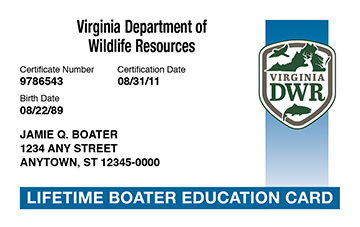
Get on the water with our fast and affordable online course. Officially approved by the VDGIF and the National Association of Boating Law Administrators (NASBLA), this Virginia boating course ensures you master essential boating safety skills and know local Virginia boating laws. Upon completion, you will receive your Boater Education Card (commonly referred to as the Virginia Boating License).

Who Should Enroll?

Who Needs This Course?

Virginia law requires all motorized watercraft operators to pass a boater safety course and to carry a boater education card, known as the Boater Education Certificate. This card (often referred to as “Virginia boating certification” or “Virginia Boater Education Card”) is proof that you have successfully completed all state-mandated boater education requirements.

Vessel operators who are required to have the Boater Education Certificate must carry their card on board the vessel and have it available for inspection by enforcement officers.

Safe & Certified Boating

The Pathway to Safe and Certified Boating

Register

5 Minutes

Complete the Course

3 Hours

Instant Certificate

1 Minute

Go Boating

Instantly

Boater say

What Boaters Say About Certified Boater

See how Certified Boater has helped boaters like you get certified, stay safe, and enjoy the water with confidence.

trusted by:

Wanda Lawson Students

“CertifiedBoater made learning Florida boating laws easy and stress-free. The course was clear, well-structured, and helped me feel confident on the water.”

Dicky Tenue Students

“The CertifiedBoater course was simple to follow and very informative. I completed it at my own pace and now feel prepared to boat safely in Florida.”

Luna Houston Students

“I really enjoyed using CertifiedBoater to complete my boating course. The lessons were straightforward, helpful, and perfect for first-time boaters.”

What You’ll Learn

What Is In Virginia Boating Course?

Before learning boating rules, you must understand basic boating terms. Boaters use these terms to communicate clearly on the water. Clear communication helps prevent confusion and accidents.

Different boats are designed for different uses. The way a boat is built affects how it moves on the water. Boat design affects how a boat handles waves and wind. It also affects how much weight the boat can safely carry.

Boating safety depends on having the right equipment on board. It also depends on knowing how and when to use that equipment.

Safe boating starts before the boat ever leaves the dock.

Safe boat operation means making safe choices on the water.

Navigation rules help prevent crashes on the water.

Boating emergencies can happen at any time.

Many waterways are shared by many people. Boats often share the water with swimmers, divers, anglers, hunters, and people being pulled on skis or tubes.

Boaters share the water with people, animals, and plants.

Boater safety reduces accidents.

Explore Course Features

certified boater course features

Instant Certification

Finish the course and get your certification immediately, so you can start boating right away.

Affordable & Aboveboard

Don't break the bank for boater education. Our course is budget-friendly, ensuring you can spend more money on the fun stuff, boating!

Safety with a Splash of Fun

This course is filled with interactive learning challenges, real life examples, and engaging videos that'll have you hooked from the first click

Live Support

Enjoy peace of mind with live customer support. We don’t expect you’ll need it, but in the rare case you do, we’ll be here to answer your call.

Frequently Asked Questions

Virginia Boating Course FAQs

What is the minimum age to take this online course?

You must be at least 16 years old to take this online course.

Is the Virginia Certified boater Course approved by the Virginia Department of Wildlife Resources?

The Virginia Certified boater Course is approved and accepted by the Virginia Department of Wildlife Resources

Do I have to complete the course all at once?

You may complete the course at your own pace. The course can be completed in one sitting or completed a little at a time over several days. All pay-up-front courses are available for 90 days from time of registration and payment.

How much does the Virginia Certified boater Course cost?

The Virginia Certified boater Course fee is $29.99

Do I have to be a resident to take the Virginia Certified boater Course?

You do not have to be a resident of Virginia to take this online course.

How do I replace my Boating Safety Certificate if I’ve lost it or it has been damaged?

To replace a lost, destroyed, or damaged Boating Safety Certificate, go to https://certifiedboater.com/.

What is the proof of online Virginia Certified boater Course completion?

Once you pass and pay for the online course, you will be able to immediately print out the Temporary Boating Safety Certificate. This is your proof of online course completion. You can print the Temporary Boating Safety Certificate right then, and/or request that a PDF be emailed to you. This certificate EXPIRES 30 days after course completion

What is the permanent Virginia Boating Safety Certificate?

The Boating Safety Certificate is proof that you have successfully completed all the education requirements. The Boating Safety Certificate will arrive within 3-5 weeks after you complete all certification requirements.

Do I have to take an online exam?

The Certification Exam is the exam you take at the end of the online course. You must score at least 80% on the exam to pass. You have unlimited attempts to pass the exam. If you don’t complete the exam in one session, don’t worry. When you log in later, you will be taken to the first unanswered question of the exam

I failed a unit quiz. Have I failed the course?

If you fail a unit quiz, you must restudy the unit and take the quiz again until you pass. You must score at least 70% on the unit quizzes to pass.

Navigate with Confidence

Boating in Virginia

Virginia offers diverse boating experiences with over 4,000 lakes and reservoirs, along with scenic rivers flowing through the Appalachian foothills. Popular spots include Smith Mountain Lake, Lake Anna, and the James River, where you can enjoy fishing, kayaking, and water sports. The state’s seasonal climate provides excellent summer boating opportunities. To fully enjoy these waters, Virginia requires boaters to complete a safety course and obtain a license, ensuring safe and responsible boating statewide.

Coming Soon States

Select the State to view resources

Alabama

Alabama Offers scenic rivers, lakes, and Gulf Coast waters ideal for recreational boating.
Alaska

Alaska Features vast coastal waters and inland waterways popular for boating adventures.
Arizona

Arizona Known for desert lakes and reservoirs that provide excellent boating opportunities.
New Hampshire

New Hampshire Features scenic lakes and rivers well suited for boating.
Colorado

Colorado Offers mountain lakes and reservoirs popular for seasonal boating activities.
Connecticut

Connecticut Features coastal waters, rivers, and lakes suited for recreational boating.
Delaware

Delaware Offers bays, coastal waters, and inland waterways ideal for boating recreation.
Arkansas

Arkansas Home to clear lakes and winding rivers perfect for recreational boating.

Boating Courses Coming Soon!

🚤 Courses on the Way!

At Certified Boater, we’re dedicated to expanding boating education nationwide. Our courses are currently available in multiple states, and we’re working toward full NASBLA approval to ensure they meet the highest safety and legal standards. Once approved, they will be recognized by state agencies.