

Online Texas Boater
Safety Course
An easy, state-approved online course that teaches Texas boating laws, safety rules, and responsible operation. Complete it at your own pace and get certified.

Official Course Approved By the Texas Parks & Wildlife Department
This course has been designed as a provider, created in collaboration with, and approved by the Texas Parks & Wildlife Department for the Texas Boater Education Card.
Website: tpwd.texas.gov
Address: 4200 Smith School Rd., Austin, TX 78744
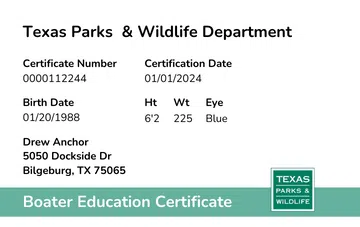
Get on the water with our fast and affordable online course. Officially approved by TPWD and the National Association of Boating Law Administrators (NASBLA), this Texas boating course ensures you master essential boating safety skills and know local Texas boating laws. Upon completion, you will receive your Boater Education Card (commonly referred to as the Texas Boating License).
Who Should Enroll?
Who Needs This Course?
Texas law requires all boat operators born on or after September 1, 1993, who will be operating a vessel powered by a motor with a horsepower of 15 or more, or a windblown vessel over 14 feet in length to carry a Boater Education Certificate.
- You must be at least 13 years old to take this online course.
- You do not have to be a resident of Texas to take this online course.
Helpful Resources
The Pathway to Safe and Certified Boating

Register
5 Minutes

Complete the Course
3 Hours

Instant Certificate
1 Minute

Go Boating
Instantly

What Boaters Say About Certified Boater
See how Certified Boater has helped boaters like you get certified, stay safe, and enjoy the water with confidence.
trusted by:
What You’ll Learn
What Is In Texas Boating Course?
Before learning boating rules, you must understand basic boating terms. Boaters use these terms to communicate clearly on the water. Clear communication helps prevent confusion and accidents.
Different boats are designed for different uses. The way a boat is built affects how it moves on the water. Boat design affects how a boat handles waves and wind. It also affects how much weight the boat can safely carry.
Boating safety depends on having the right equipment on board. It also depends on knowing how and when to use that equipment.
Safe boating starts before the boat ever leaves the dock.
Safe boat operation means making safe choices on the water.
Navigation rules help prevent crashes on the water.
Boating emergencies can happen at any time.
Many waterways are shared by many people. Boats often share the water with swimmers, divers, anglers, hunters, and people being pulled on skis or tubes.
Boaters share the water with people, animals, and plants.
Boater safety reduces accidents.
certified boater course features
Instant Certification
Finish the course and get your certification immediately, so you can start boating right away.
Affordable & Aboveboard
Don't break the bank for boater education. Our course is budget-friendly, ensuring you can spend more money on the fun stuff, boating!
Safety with a Splash of Fun
This course is filled with interactive learning challenges, real life examples, and engaging videos that'll have you hooked from the first click
Live Support
Enjoy peace of mind with live customer support. We don’t expect you’ll need it, but in the rare case you do, we’ll be here to answer your call.
Texas Boating Course FAQs
A Texas TPWD-approved boater safety course is designed to teach the fundamentals of safe boating. It covers navigation rules, federal and Texas boating laws, safety equipment, and responsible boating practices. The course aims to reduce boating incidents on Texas waterways.
In Texas, if you were born on or after 9/1/1993 you must complete a boating safety course..
The Texas Parks & Wildlife Department encourages all boaters get the Boater Education Card to stay familiar with Texas laws and regulations.
All states and Canada recognize the Texas Boater Education Card received from courses that are NASBLA (National Association of State Boating Law Administrators) approved. This is known as Reciprocity.
The Texas boating course typically takes 3-6 hours if taken online. The online format allows Texas users to complete it at their own pace, starting and stopping as needed. Set aside a weekend for Texas Parks & Wildlife Department sanctioned in-person courses.
The cost can vary depending on the course you choose. Most TPWD-approved courses are $35 – $60. The certifiedboater course for Texas is $29.99 and has a pass guarantee. If you don’t pass, you get your money back.
Yes, most states offer the option to take the boater safety course online, providing a convenient way to learn at your own pace from anywhere.
Yes, to receive a Texas Boating Safety Education I.D. Card, you must pass a final exam at the end of the course.
The Texas Boater Education Card does not expire and is valid for life.
Yes, most course providers in Texas allow you to retake the exam if you do not pass on your first attempt. certifiedboater has a pass guarantee. You can retake the Texas boating exam and course for free if you fail the first time or get your money back.
If you lose your Texas Boater Education Card, you should contact the Texas Parks & Wildlife Department. There may be a process and fee for issuing a replacement.
Navigate with Confidence
Boating in Texas
Texas offers a diverse range of boating experiences with over 7,000 lakes and reservoirs and 367 miles of coastline along the Gulf of Mexico. Popular spots include Lake Travis, Lake Texoma, and the Texas Gulf Coast, where you can enjoy fishing, sailing, and water sports. The state’s warm climate makes it a year-round boating destination. To fully enjoy these opportunities, Texas requires boaters to complete a safety course and obtain a license, ensuring safe and responsible boating on its waters.
Select the State to view resources

Alabama
Alabama Offers scenic rivers, lakes, and Gulf Coast waters ideal for recreational boating.
Alaska
Alaska Features vast coastal waters and inland waterways popular for boating adventures.
Arizona
Arizona Known for desert lakes and reservoirs that provide excellent boating opportunities.
New Hampshire
New Hampshire Features scenic lakes and rivers well suited for boating.

Colorado
Colorado Offers mountain lakes and reservoirs popular for seasonal boating activities.
Connecticut
Connecticut Features coastal waters, rivers, and lakes suited for recreational boating.
Delaware
Delaware Offers bays, coastal waters, and inland waterways ideal for boating recreation.
Arkansas
Arkansas Home to clear lakes and winding rivers perfect for recreational boating.